Homeownership and the Racial Wealth Gap

Presented March 5, 2024 at the Newark Public Library

.

.

The world’s largest concentration of wealth is in the New York City metropolitan area, yet the region contains many under-resourced cities, including Newark. What historical factors created this division between low-income Newark and its wealthy neighbors along lines of race, housing, income and social class?
The agents of change are more complex and nuanced than a simple narrative of redlining and white flight following the 1967 uprising. From discriminatory actions by the Federal Housing Administration and highways that carved through the urban fabric, to suburbs that pulled middle-class families away from Newark and factories that relocated outside of the city, contemporary poverty in Newark was more than a century in the making.
Drawing from the archives of the Newark Public Library, this presentation examines the range of challenges Newark faces and how the city overcomes. This is a Newark History Society program, co-sponsored by NJPAC and the Newark Public Library. Light refreshments will be served.
The presenter is Myles Zhang, urban historian and doctoral candidate at the University of Michigan in Ann Arbor.
This presentation will evolve into my dissertation entitled:
“An island of poverty in a vast ocean of material prosperity”:
Homeownerhip and the Racial Wealth Gap in Newark

.

.

.

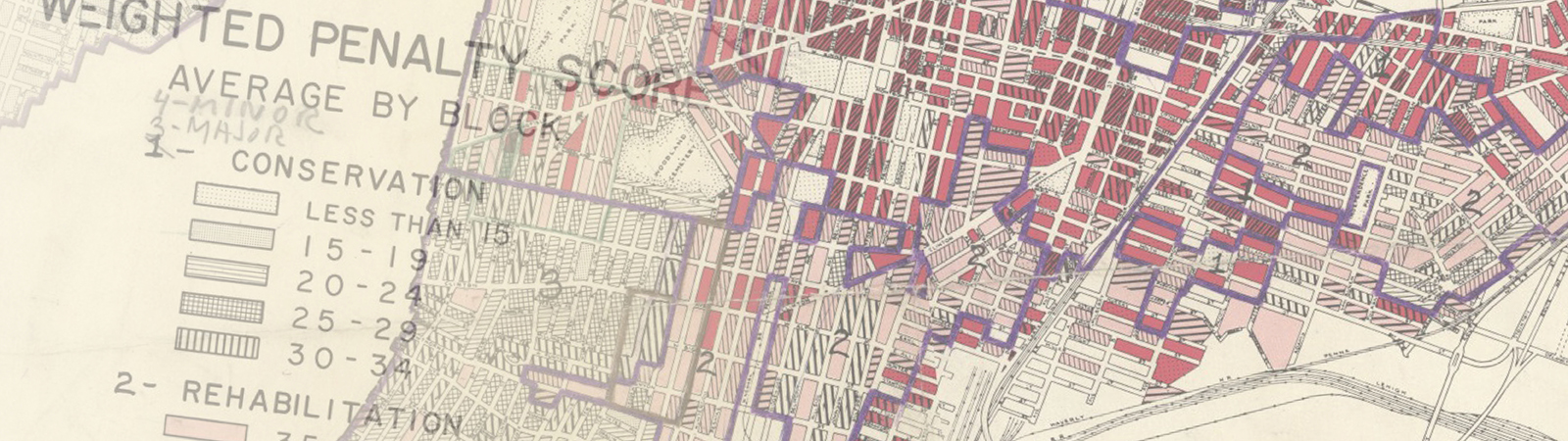
1959 Map of “Blighted” Areas by Newark Central Planning Board

.

View event on NJPAC website

Newark Changing: Mapping neighborhood demolition, 1950s to today


Click to launch interactive mapping experience.

.

Newark Changing is a first-of-its-kind visual encyclopedia of 2,400 photo comparisons of almost every street corner​​​, home, and building ​​demolished by urban renewal and the social forces behind urban decay.​ Through an interactive and text-searchable historic map, any visitor can travel in time to explore their street and their building as it appeared in the period 1959-68 vs. today. Thousands of old street photos are brought to life with contemporary 360-degree panoramic photos of the same street scenes today, taken from identical camera angles to the old photos. This is the most extensive collection of photo comparisons past and present ever assembled for any American city.
Newark Changing reveals the scale and devastation of urban renewal, not from the aerial perspective of the city planner’s map but from the human perspective of the street corner and neighborhood. Tens of thousands of individual streets, homes, apartments, churches, and Jewish, Black, and Italian-owned businesses in Newark were “redlined” in the 1930s and deprived of investment. Most of these neighborhoods today have been bulldozed for interstate highways, universities, hospitals, and corporate investments in real estate. Billions in taxpayer money (adjusted for today’s value with inflation) was spent in the period 1945 to 1967 to demolish at least 10,000 buildings, displacing 50,000 people, 65-77% of whom were Black. At the same time, the migration of people and jobs away from urban centers deprived cities like Newark of the industrial employment base they once had. Decades after the 1967 rebellion, Newark still struggles to confront and overcome decades of harm inflicted on the city by de-industrialization and population loss to the suburbs.
Street scenes can be browsed by interactive map, by neighborhood, by subject, by street, or by the public institution responsible for demolition. Visitors can thus travel in time to explore today’s empty fields, parking lots, and desolate streetscapes for the vibrant neighborhoods they were before the automobile age.

Launch interactive mapping experience >

University of Michigan PhD Application

The following statements accompanied my successful application in fall 2020 to the architecture PhD program at the University of Michigan’s Taubman College of Architecture and Urban Planning. I received a full scholarship for six years with a graduate student stipend. I share these statements online for future applicants to Michigan or architecture PhD programs in general. These statements are no “template” for others’ applications. Just because this format worked for me does not mean it will work for others.
Personal statement
Research statement
Design portfolio
Curriculum vitae

.   Some B’s mixed in there, not all A’s

Columbia University transcript
Oxford University transcript
GRE scores

This was my CV at time of application. My current CV is linked to here.

I applied to an architecture program not having had an undergraduate or Master’s degree in architecture; many applicants have this. My undergraduate GPA in the “History and Theory of Architecture” major at Columbia was 3.9. The three people who wrote letters for me were Kenneth T. Jackson (history), Gergely Baics (history), and Stephen Murray (art history). As the country’s leading urban historian, Professor Jackson’s recommendation was important because my PhD research proposal described my interest in urban history. Professors Baics and Murray’s advice was equally important in demonstrating past research experiences. As a large and well-funded research university, Columbia equipped me with opportunities to work with faculty like them on independent research projects.
Applying to PhD programs is a crap shot. Hundreds of people apply to a handful of spots at a few elite programs. Those who are accepted are not categorically more qualified than those rejected. Perhaps there’s some extra feature in successful applications that sets them apart from unsuccessful ones. At least in my case, my design portfolio that demonstrated my artistic sensibility helped offset my lack of an undergraduate degree in architecture. The match in research interests between my research proposal and the work of Michigan faculty members like Robert Fishman and Joy Knoblauch was an added plus. However, I can just as much see myself having been rejected from Michigan with an identical application had I applied the previous year, had there been fewer places, or had there been different members of the admissions committee. This isn’t a criticism of Michigan either because all the top schools have more applicants than places and must therefore reject thousands of qualified people.
My advice to people considering a PhD is to be persistent about applying. I applied to fifteen graduate programs three years in a row before I was accepted anywhere. The application process is long, tedious, and hard to enjoy because applying feels like putting my heart and soul into courting a program just to be turned down with a generic rejection letter. I realize it is a privilege to have the time, money, and energy so much as to even apply. For a wealthy school with multi-billion dollar endowment to ask an applicant to fork over money for an application that will most likely be rejected feels like an extra jab. In my case, however, I cannot see myself doing much else other than teaching and researching in a university environment. So the time and energy investment made sense, despite 2020 being a uniquely difficult application year during the coronavirus when hundreds of programs were no longer accepting students. I am all the more grateful to be here.